

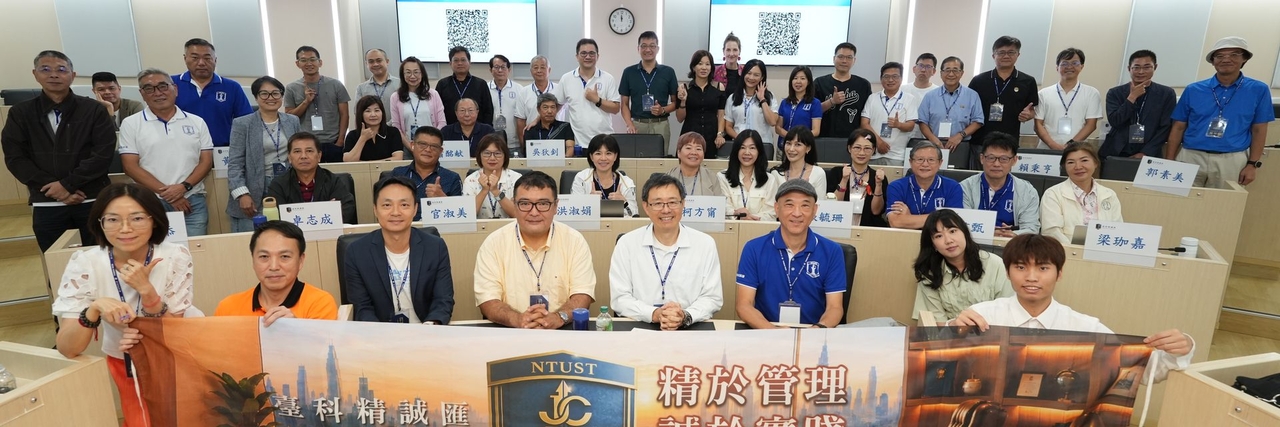
Exploring Taiwan’s AI future, ASUS Co-CEO S.Y. Hsu notes that Taiwan AI infrastructure is rapidly transforming global tech. ASUS leads this shift into a complete solutions provider, showcasing agentic AI tools like Zenni Claw and AI Hub with enterprise servers at NTUST. Deepening university partnerships helps ASUS invest in the vital talent pipeline needed to sustain long-term technological innovation and economic growth.
Ryl D.– | Traffic Network PH
Powering the AI Economy: Reflections from My Visit to NTUST
OFFICIAL RELEASE: ASUS | PUBLISHER: ADVAI
- Taiwan is having its moment, ranked 4th in the 2026 IMD World Competitiveness Ranking, with GDP per capita now among the world’s highest and AI powering a new phase of national growth.
- ASUS has become a different company, moving from PCs to a full AI stack spanning infrastructure, devices, and applications, with AI server revenue up more than 5x.
- Agentic AI is now practical, not theoretical,through products like ASUS Zenni Claw and the ASUS AI Hub, already used internally by thousands of employees.
- The next chapter depends on talent,which is why we’re deepening our partnership with NTUST to build the AI skill set pipeline Taiwan and ASUS will need.
I recently spent some time at National Taiwan University of Science and Technology talking with students and faculty about where Taiwan’s technology story is headed next, and where ASUS fits in. It’s a conversation I don’t get to have often enough, so I wanted to expand on a few points here.
Taiwan’s growth is no longer just about hardware
Taiwan’s GDP per capita has climbed to among the world’s highest, and the IMD now ranks us 4th globally for competitiveness. That didn’t happen by accident. It’s the product of a specific formula: forward-looking government policy, a resilient and adaptable national culture, absolute dominance in semiconductors, AI servers, and PCs, and a supply
chain that’s deeply integrated rather than loosely connected.What’s changed is the layer above the hardware. Taiwan produces roughly 90% of the world’s leading-edge semiconductor manufacturing capacity and around 90% of global AI server shipments. That gives us a complete AI supply chain few other economies can match.
The opportunity now is turning that capacity advantage into an applications advantage — computing power, models, and ISV/SI partners feeding each other rather than operating in isolation. Taiwan has already stood up eight of the world’s AI supercomputers on the Top 500 list; ASUS led five of them.
From PC company to AI solutions provider
ASUS‘s own path mirrors Taiwan’s. We started as a “small and beautiful company” out of a Taipei coffee shop, and for most of our history we were known as a PC maker. Today, PCs are one piece of a much bigger picture. Our server business has grown more than 5x, and Infrastructure Solutions now makes up 36% of brand revenue. Ubilink, Taiwan’s largest supercomputing facility, runs on 128 of our ESC N8-E11 servers — a good example of what “AI solutions provider” means in practice.
Our AI PC business is growing alongside it: AI PCs now account for over half of our PC revenue, and we hold more than 25% share of the global Copilot+ AI PC market, built on partnerships with AMD, Intel, NVIDIA, and Qualcomm. That’s the strategy behind “Ubiquitous AI. Incredible Possibilities“— devices, infrastructure, and applications working as one stack, not three separate businesses.
Making agentic AI real, not theoretical
The AI conversation is shifting from generative to agentic, and that shift favors companies that control both hardware and software. ASUS Zenni Claw is our answer: one-click setup, ready-to-use ASUS skills, and flexible local-cloud routing designed to make agentic AI something people actually use, not just discuss.
Internally, the ASUS AI Hub is already boosting employee productivity, with more than 3,000 employee-created AI assistants running on it at roughly 5% the cost of a typical subscription alternative. But tools alone are not enough.
Three years ago, we formed a Gen AI Committee to guide responsible adoption and began expanding practical training so employees can apply AI in their daily work. We’re extending the same thinking outward — an agentic business intelligence
assistant for faster decision-making, and an AI customer assistant now live across more than 40 countries. The feedback we hear most often from users is the simplest kind of validation: it understood what they needed and got them there.
Investing in the people who come next
None of this works without talent, which is why I wanted to spend this time at NTUST. At ASUS, we treat AI readiness as a long-term investment — giving employees the tools, training, and support to build practical skills and keep adapting as the technology evolves. The same principle applies to the next generation. We talked through the skill set checklist I think Gen Z needs to build a career in AI — not just technical fluency, but the judgment to apply it responsibly. Taiwan’s AI advantage was built by a generation that combined engineering depth with the willingness to bet on something unproven. The next phase needs the same combination, and universities like NTUST are where that gets built.
The takeaway
If there’s one thing I hope the students left with, it’s that Taiwan and ASUS are both further along this AI transition than most outside narratives give credit for — and that the opportunity ahead is bigger than the one we’ve already captured. I’m grateful to NTUST for the platform to make that case, and I’m looking forward to seeing how many of those students end up building the next part of this story with us.




Elevate your digital journeys in tech-driven mobility with Traffic Network PH, powered by ASUS.


